The average American now spends over seven hours a day glued to a screen, with most of that time wasted on TikTok videos, Instagram reels, and Netflix binges that leave people wondering where their time has gone. However, more than 120 million people have turned that same screen time into something that makes them smarter. They have replaced doomscrolling with Duolingo: the free, addictive language app that teaches more than 40 languages through bite-sized, gamified lessons designed to feel more like playing than learning.
Why It’s Impossible to Put Down
Duolingo uses the same psychological wiring that keeps people scrolling on TikTok and rushing through Candy Crush levels, and applies it to learning a foreign language. Every correct answer triggers a flood of dopamine, accompanied by exquisite animations and satisfying sound effects that keep users coming back. This turns language practice into an addictive daily micro-habit. Each lesson, ranging from five to ten minutes long, removes the excuse “I don’t have enough time,” and spurs people to build their streak. This is not accidental but deliberate behavioral engineering that turns studying into a game you don’t want to put down.
Duolingo’s playful spirit spills over into its marketing, creating a brand that feels less like a stale high school Spanish classroom and more like a global competition, as you race your way to the top of the leaderboard against people and friends all around the world. However, Duo, the owl mascot, has become a key component of their advertising, being equal parts adorable and unhinged, sending push notifications like "I'm not that upset, it's just allergies" to "Nobody ignores me... for long." This green owl has starred in everything, from viral TikTok memes where he shows up at your door with a baseball bat if you miss a day of lessons, to being featured in a Saturday Night Live Skit. This self-aware humor makes the brand feel alive and cheeky rather than corporate or stuffy. Emphasizing that learning a foreign language doesn’t have to be serious or intimidating; it can be ridiculous, shareable, and even enjoyable. Duolingo, using this innovative style for marketing and design, breaks down the psychological barriers that make starting to learn a language so intimidating and keeps users engaged with its playful marketing and notifications long after the initial download.
Behind the Scenes
The gamified style and creative marketing of Duolingo contributed to its popularity, but behind the scenes, evidence-based learning techniques have enabled it to measure up against college-level language classes. An independent study from the American Council on the Teaching of Foreign Languages (ACTFL) found that beginners who completed Duolingo’s Spanish course performed roughly as well on reading and listening tests as students who had finished up to four college semesters of Spanish Study. For a freemium app, where you only pay if you decide to go ad-free or want the Duolingo Max subscription, these are results that you won’t find easily anywhere else.
Of course, Duolingo isn’t perfect, and the company is refreshingly open about that. Once the early excitement fades, advanced units can start to feel repetitive, and no amount of gamification can fully reproduce the unpredictable flow of real conversations with native speakers or the subtle cultural signals you only absorb by living in a country. However, the app’s famously surreal sentences have become internet legends for a reason: chances are you will never need to say “The duck is wearing a suit,” or “Are you eating the homework?” in actual conversation. That very weirdness, however, is deliberate. The oddity acts as a memory hook, lodging vocabulary and grammar in long-term storage so you can later repurpose the words in normal sentences. Although, critics are correct that the heavy focus on streaks and points sometimes rewards consistency over depth, and the app by itself will not carry most users all the way to native-level fluency. For millions of people who would never otherwise have opened a textbook, booked a tutor, or stepped into a classroom, though, those trade-offs are overwhelmingly worth it. They are reading menus, texting friends, holding real conversations, and discovering entire cultures, often for the first time in their lives.
Most people never fully realize the science; you just notice that six months later, you can walk into an Italian café and confidently order “Un caffè con zucchero, per favore” without translating it in your head first. That’s spaced repetition doing its work in the background with the app constantly tracking what you have been learning, and resurfaces words and grammar exactly when you are about to forget them. Then there are the multiple learning styles in every lesson with bite-sized units incorporating reading, listening, speaking (via microphone tasks), and translation tasks. Whether you are a visual, auditory, or kinesthetic learner, you are covered. The app even adapts in real time: struggle with speaking? It serves more spoken exercises until you improve. Lastly, the mastery-based progression ensures you don’t move forward until you have truly grasped a concept. The app uses an internal strength meter for every skill: ensuring you are building real proficiency rather than the illusion of progress.
Statistics That Prove It is Worthwhile
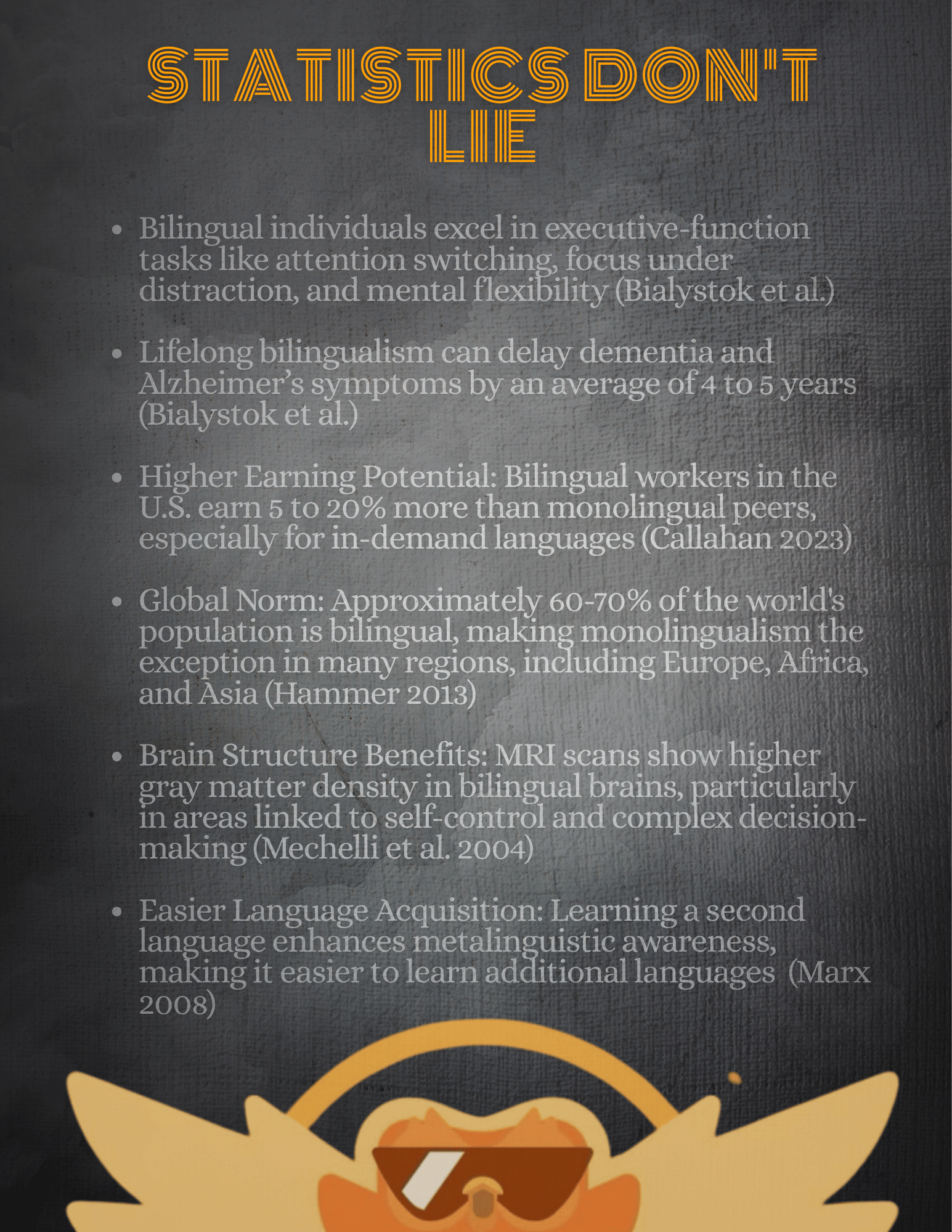
Suppose you're still not convinced that replacing hours of mind-numbing scrolling with Duolingo is one of the best investments you can make with your time, consider the scientific evidence. Learning a second language is not just about being able to order croissants in Paris; it literally rewires your brain for the better and provides lifelong benefits. The brain simply does not receive the same cognitive workout from watching Netflix as it does from practicing and learning a foreign language. Bottom line, Duolingo won’t have you speaking Spanish, Italian, Russian, or any of its other languages overnight. However, every day you protect your streak is a better use of screen time because you’re not only learning a foreign language, but you can also potentially increase your income and change how your brain works on a cognitive level.


 Printer-friendly version