
Ticketworthy - The Uprising [1]
The Uprising – 2026 – 128 Minutes – Rated R
4/5 ★
Based on the true story of the 1381 Peasants’ Revolt in England, The Uprising spends nearly all of its runtime showcasing the bloodiest and most seditious elements of any revolution. Although there are creative liberties taken, such as certain characters and scenarios, this film efficiently portrays a truly sanguinary event in history with incredible action, dialogue, and a wide spectrum of emotionally driven personalities.
 [2]
[2]For as long as the film industry has been a prevalent part of pop culture, so has the production of motion pictures either based on true stories from or merely set during the Middle Ages. The fascination audiences have with these period-piece dramas is captured immediately within The Uprising. Written and directed by Paul Greengrass, most known for his direction of Captain Philips (2013), the movie wastes no time immersing the viewer in the anguish of 14th century England.
Despite its devastation to all classes, The Black Death affected lower-class and rural populations the worst in the mid-1300s. The peasants, even roughly 30 years after the Black Death, have not been able to recover from the decimation of their livelihood. When the already impoverished population of the Essex village of Fobbing are visited by English government officials to receive the payment for their incredibly unpopular poll tax, the peasants fight off the soldiers and taxer and launch a revolution.
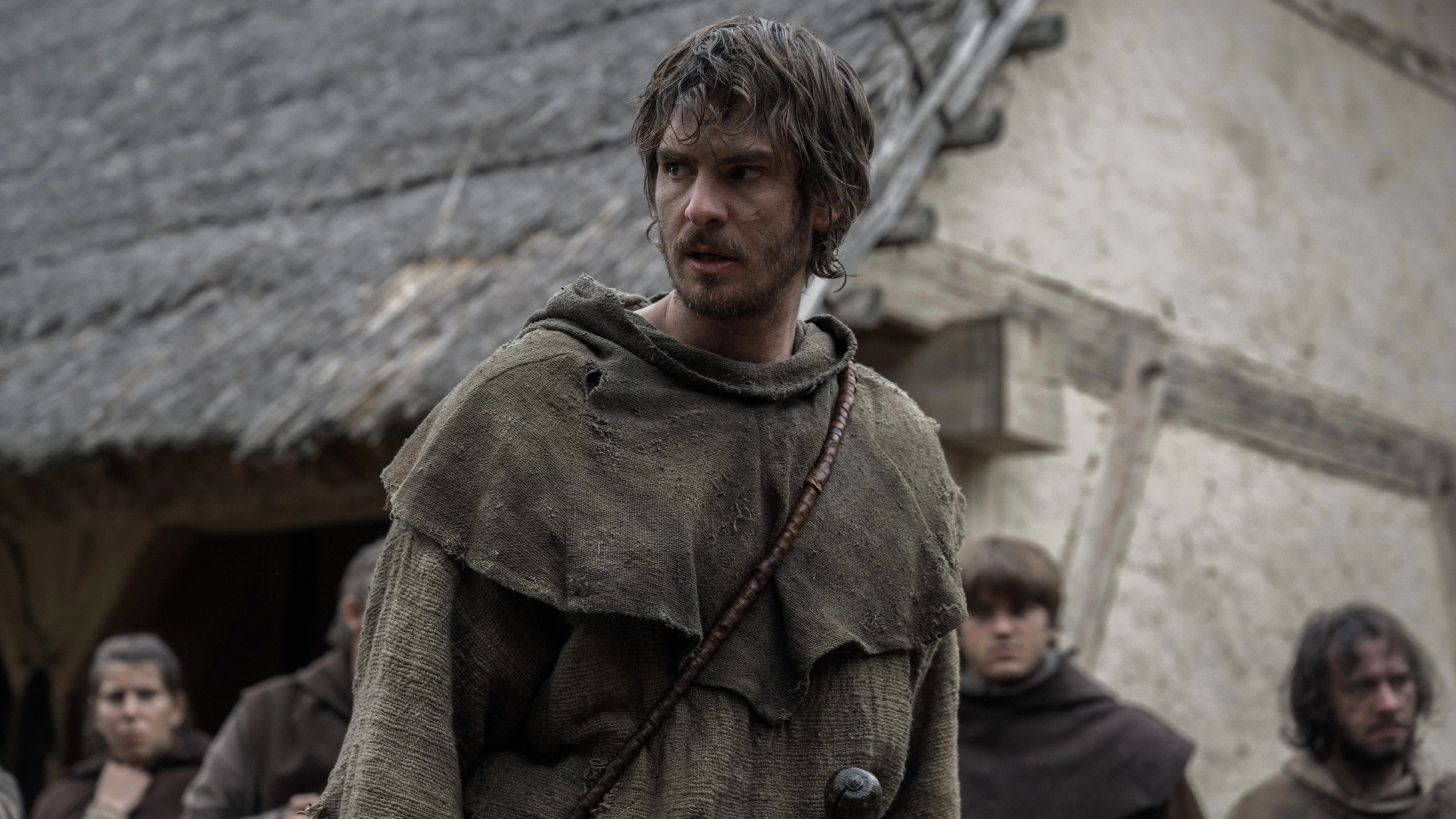
Although the narrative spotlights important members of the rebellion, such as Wat Tyler (Cosmo Jarvis) and John Ball (Jamie Bell), the protagonist, played by Andrew Garfield, is simply named “Ploughman”, after his job. The choice to focus on an “everyman” rather than a well-known figure was very much intentional; this allowed for creative liberties to be taken, while not shying away from the important accuracies of this historical event and its contributors. The story follows Ploughman as he navigates the revolution, through the bloody skirmishes and anger-driven negotiations between the peasants of multiple villages and the kingdom of England. This narrative showcases the polarizing perspectives of many people, such as farmers, peasants, clergymen, soldiers, and royalty in a remarkable fashion.
Despite the rational fear of inaccuracy presented by a 14th century historical drama, The Uprising, in my opinion, takes its creative liberties in a respectful way. Although there are minor inaccuracies in terms of deaths and timeline, the lack of complete authenticity does not mean there is an inability to present themes of morality, humanity, and class-division in a provocative manner. In terms of flaws, the dialogue, although written very well, can be hard to understand, as well as the cinematography being overwhelming with its use of unsteadiness. Besides those aspects, this film uses accurate backgrounds and set pieces to showcase the most important elements of a true story and its themes that are still relevant in the modern day.
The themes of morality and humanity are incredibly well approached in this movie. Despite core tenets of revolution, being the ideas of brotherhood and unity, The Uprising shows how the motives of multiple characters are diverse and lead to disagreement. Obviously, the conflicting beliefs on nobility and power are present between the kingdom and the peasants, but there is also conflict within the rebellion itself regarding justice and destruction. Our protagonist is shown to believe in the goals of the revolution yet wishing for much less bloodshed than what has resulted. Not only is the bloodshed a key part of the perspectives of each character, but it is also shown in a barbaric and direct manner. There is, in no way, a lack of gore. Comprehensively, the approach to conflicting and varying opinions on radical principles, and its consequences is presented incredibly well, showcasing a multitude of beliefs and ideologies, as well as the difficulties, inside and out, of any insurrection.
When examining violence in an insurrection, it is not fair to portray people as lacking nuance, nor to depict anyone as purely heroic or villainous; that goes against the very methodology of history. In the case of The Uprising, its ability to represent many different philosophies and doctrines in a complex and historical way, as well as being able to showcase action in a savage and intense manner, is what elevates this film from the oversaturated genre it is characterized by.